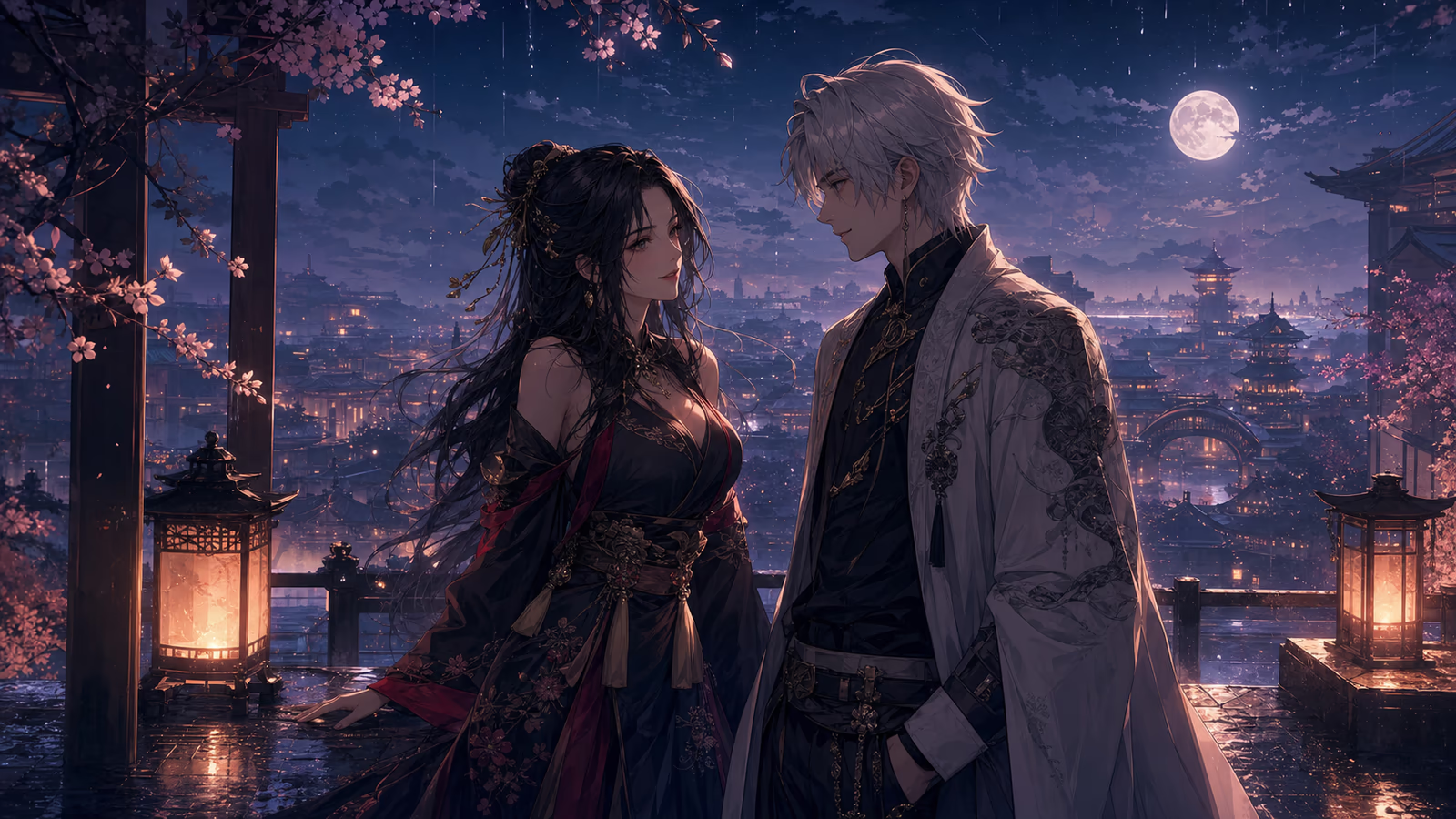
A good roleplay image should do more than show a recognizable face. It should feel like the same character, in the same story, at the exact moment the conversation has reached.
That sounds obvious. In practice, it is one of the hardest parts of visual roleplay.
An image can be beautiful and still feel wrong: an anime face placed in a live-action room, a familiar avatar outfit copied into a scene where it makes no sense, or a character twisted into an awkward pose because too much of the original reference was preserved. A picture like that may resemble the character, but it does not belong to the story.
We have rebuilt Reverie's roleplay image experience around that distinction. The goal is not simply better-looking images. It is to create images that understand what should remain consistent, what should change with the scene, and when a fresh composition matters more than copying a reference.
One Scene, One Visual Language
Roleplay imagery on Reverie now begins from a polished, Japanese-anime-inspired 2.5D direction.
This is not just a face treatment. The character, body, clothing, props, lighting, and background are instructed to share the same illustrated world. When no reference image is available, scene generation still stays anime-first instead of drifting toward live-action photography.
The result should feel closer to a premium character key visual:
- expressive anime faces with dimensional shading
- illustrated skin and fabric rather than photographic texture
- cinematic light that belongs to the environment
- painterly backgrounds with real depth
- consistent proportions from face to full body
You can still choose another style in Advanced settings. Reverie remembers that preference for the character, so you do not need to select it again for every image.
The Avatar Is an Identity Anchor, Not a Cage
Reference images are powerful, but using one for every request can make a scene worse.
A reference is ideal for a portrait, selfie, close-up, or simple standing or seated pose. In those cases, it helps preserve the character's face, hair, and other stable traits.
But a dramatic action scene, a full-body pose, a major outfit change, an intimate transformation, or a scene with several characters needs more freedom. Trying to bend an avatar into those compositions often preserves the wrong things: the old crop, the old clothing, or even the old pose.
Reverie now decides whether the current scene benefits from an identity reference. For complex compositions, it can create the scene fresh while carrying the character's identity through the written description. Anatomical and compositional quality takes priority over forcing a reference into every request.
Wardrobe follows the story, too. The order is simple:
- your custom description
- the current message
- clothing already established in the recent conversation
- a scene-appropriate choice
An avatar's outfit is character lore, not a permanent uniform.
The Conversation Becomes the Shot List
When you generate an image from a message, Reverie now reads the recent conversation and treats the current message as the moment to depict.
The scene planner identifies:
- who is actually present
- what each character is wearing now
- the current expression and emotional tone
- one physically coherent frozen action
- the setting, props, camera angle, and lighting
- whether the scene needs a standard or mature generation path
- whether an avatar reference will help or hurt
It also avoids inventing the user as an extra character. In most roleplay scenes, you remain the camera—the point of view—unless the scene only needs a non-identifying hand or arm at the edge of the frame.
For group chats, the system chooses the cast from the moment being illustrated instead of placing every character in every picture. Multi-character scenes receive an explicit composition, while characters who are not part of that moment stay outside the frame.
Edit the Whole Image—or Just the Part You Mean
The image editor now supports two different intentions.
Whole-image editing is useful when you want to change the overall mood, weather, setting, or composition.
Regional editing lets you select an area of the image and describe what should change there. Reverie gives the selected area enough surrounding context to understand it, while protecting the rest of the image as much as possible.
That makes common fixes much more practical:
- change a piece of clothing without rebuilding the whole scene
- replace a prop or accessory
- adjust a small background detail
- correct one part of an image that missed the prompt
Generative editing is not pixel-level photo retouching, and a small selection can still influence nearby details. But the intent is now explicit: change this area, preserve everything else.
Mature Scenes Without Keyword Guessing
Reverie supports many languages, and a list of keywords was never a reliable way to understand a visual request.
Scene routing now comes from structured interpretation of the actual image being requested. The system decides based on what will be visible—not merely the language used, and not simply whether a character profile allows mature content.
That means an ordinary café scene with a mature-enabled character can stay on the standard path, while a request that actually contains nudity or explicit content uses the appropriate mature path. The classification travels with the same scene plan that determines the cast, action, wardrobe, and composition.
This is more accurate across languages and better aligned with the picture the user is actually asking for.
Clearer Pricing Before You Create
The new generation paths have different costs. The image interface shows the applicable credit amount before generation, and the Image Generator plugin now explains its pricing before installation.
| Generation path | Credit cost |
|---|---|
| Standard scene generation | 10,000 |
| Mature scene generation | 15,000 |
| Character-consistent generation and image editing | 30,000 |
Existing Image Generator plugin installations were removed so users can review the updated pricing and actively agree before installing it again. We chose a fresh installation over silently changing the cost of something already enabled.
What to Try
Open a conversation and generate an image directly from a message. Start without a custom description and see how the current moment is interpreted.
Then try one of these:
- ask for a selfie or portrait and compare identity consistency
- request a full-body action scene and let composition take priority
- change the character's outfit through the conversation
- generate a scene with two or more characters
- select one region of an existing image and replace only that detail
- choose another visual style in Advanced settings and keep it as the character's preference
Visual roleplay will keep evolving. This update gives it a stronger foundation: one coherent art direction, identity without rigidity, scenes that follow the story, and editing tools that understand what you actually meant to change.
Your characters should not look pasted into a picture. They should look like they live there.
Credit costs and supported generation paths reflect the product at the time of publication. The interface always shows the current cost before generation.